
Key takeaways:
- Kamado smoking comes down to three moves: a heat deflector for indirect cooking, vent control for temperature, and the snake method for duration.
- The working range is 105 to 135 degrees Celsius. Stability comes from the ceramic, not from constant fiddling.
- On wood, two or three chunks are plenty: a kamado is airtight, so smoke stays inside far longer than in an open barbecue.
- The costliest beginner mistake is opening the lid to check. Every opening feeds the fire and spikes the temperature.
Most kamados are bought for grilling and discovered as smokers a few weeks later. That makes sense: the egg shape and thick ceramic make it one of the few domestic cookers able to hold a low temperature overnight. The catch is that a kamado is not controlled like a steel barbecue.
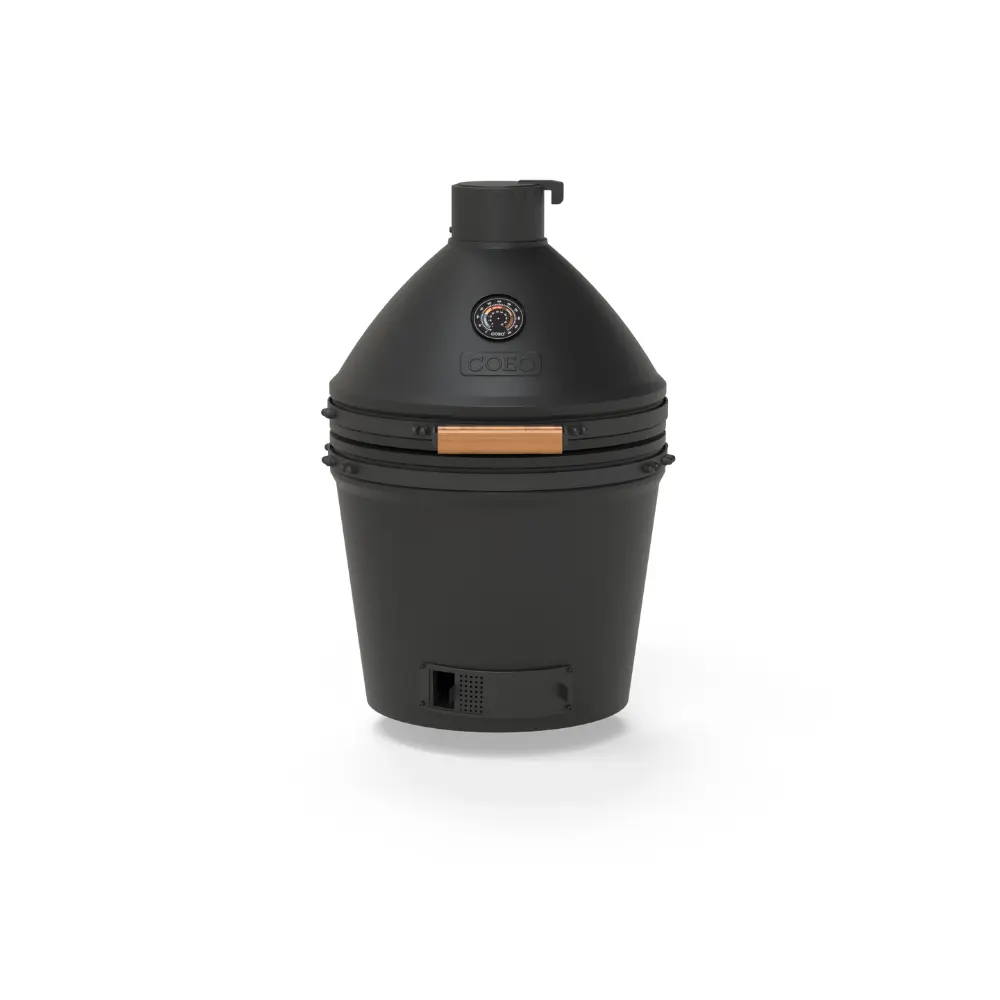
The heat deflector, without which nothing works
With no deflector, the coals radiate straight onto the meat: that is grilling, not smoking. The deflector, a ceramic or cast iron plate placed between firebox and grate, blocks that radiant heat and makes hot air circulate around the food.
It is the accessory to check before buying, since not every model ships with one. On QUATRO kamados from French brand COEO, the ceramic is 35 mm thick with a lifetime warranty, and a modular grate system allows several cooking configurations.
Controlling temperature: two vents, no rush
The principle is simple, the execution takes patience:
- The bottom vent controls incoming air, so combustion intensity. This is the coarse adjustment.
- The top vent controls exhaust, so draught and smoke circulation. This is the fine adjustment.
The rule that prevents most failures: approach the target temperature from below. A kamado that shoots to 200 degrees takes a very long time to come back down to 120, because the ceramic has already stored that heat. A slow climb, by contrast, settles easily. Each adjustment should be tiny, a few millimetres of vent opening, followed by ten to fifteen minutes of waiting.
The snake method, for overnight cooks
Rather than filling the firebox loosely, charcoal is laid in a trail along the wall, one or two layers deep, like a snake. Only one end is lit: the coals then burn along the trail at a steady pace.
The benefit is twofold. Temperature stays stable without intervention, and burn time can be planned in advance from the length of the trail. Smoking wood chunks are spread along the path, which spreads smoke across the whole cook instead of releasing it all in the first hour.
Wood: less is more
| Wood | Intensity | Recommended use |
|---|---|---|
| Apple, cherry | Mild, slightly sweet | Poultry, pork, fish, first attempts |
| Beech | Mild and neutral | Versatile, good learning wood |
| Oak | Medium | Beef, long cooks |
| Mesquite, hickory | Strong | Fatty beef only, use sparingly |
Two or three fist-sized chunks cover an entire cook. A kamado’s seal keeps smoke inside much longer than an open barbecue, and excess smoke leaves a bitterness that cannot be fixed afterwards.
Mistakes that ruin a cook
- Opening the lid to look. Every opening lets air rush in, revives combustion and spikes the temperature. A probe removes the need.
- Overshooting on the way up. Coming back down takes far longer than going up, because of ceramic inertia.
- Trusting time instead of internal temperature. Two cuts of equal weight rarely cook at the same pace.
- Using poor charcoal. Charcoal that produces heavy ash will choke the bottom vent mid-cook.
Where to start
Chicken thighs and pork shoulder make the best first cuts: fatty and forgiving, they tolerate temperature swings. Brisket demands control and is better kept for later, as covered in our guide to the best ceramic kamado for low and slow brisket.
On choosing the cooker itself, our comparison of the best ceramic kamado for value for money and our Kamado Joe or French kamado analysis go through the criteria that actually matter, starting with ceramic thickness and gasket quality.