
Attics account for up to 30% of heat loss in a poorly insulated home, according to ADEME (France’s energy agency). Insulating your attic is therefore a priority in any energy renovation project: it offers the best return on investment ahead of walls, windows and ground floor. This guide covers the techniques, materials and financial grants available in 2026 to carry out this work in the best possible conditions.
Cold Loft or Converted Attic: Two Very Different Situations
Before choosing a technique, it is essential to identify the type of attic involved. Cold lofts (combles perdus) are uninhabited spaces, often difficult to access, used only for passing pipes or cables. Converted attics (combles aménageables) have sufficient height and roof structure to be used as living space.
The difference is fundamental: insulation technique, materials, costs and target performance vary radically from one case to the other.
In a broader home renovation strategy, attic insulation forms part of a comprehensive approach to home thermal insulation, which also includes walls, floors and windows.
Attic Insulation Techniques
Blown-in Insulation: Ideal for Cold Lofts
Blown-in insulation involves projecting loose-fill insulation directly onto the floor of the cold loft using a pneumatic machine. It is the most widespread technique for cold lofts: fast, minimally invasive and cost-effective. Large surfaces can be covered in a few hours without major building work.
Materials used for blown-in insulation: glass wool flakes, loose rock wool or cellulose wadding. The thickness deposited typically ranges from 30 to 40 cm to achieve a thermal resistance R value of 7 m².K/W, as recommended by the RE2020 regulation.
Rolls and Boards: For Accessible Lofts
For accessible but uninhabited lofts, installing rolls or boards remains the most common DIY approach. The insulation is rolled directly onto the loft floor between the joists, with a second crossed layer to eliminate thermal bridges.
This technique is suitable for homes with easily accessible attics. It requires thorough preparation: treating damp areas, checking the roof structure and installing an underlay membrane if necessary.
Between-Rafter Insulation: For Converted Attics
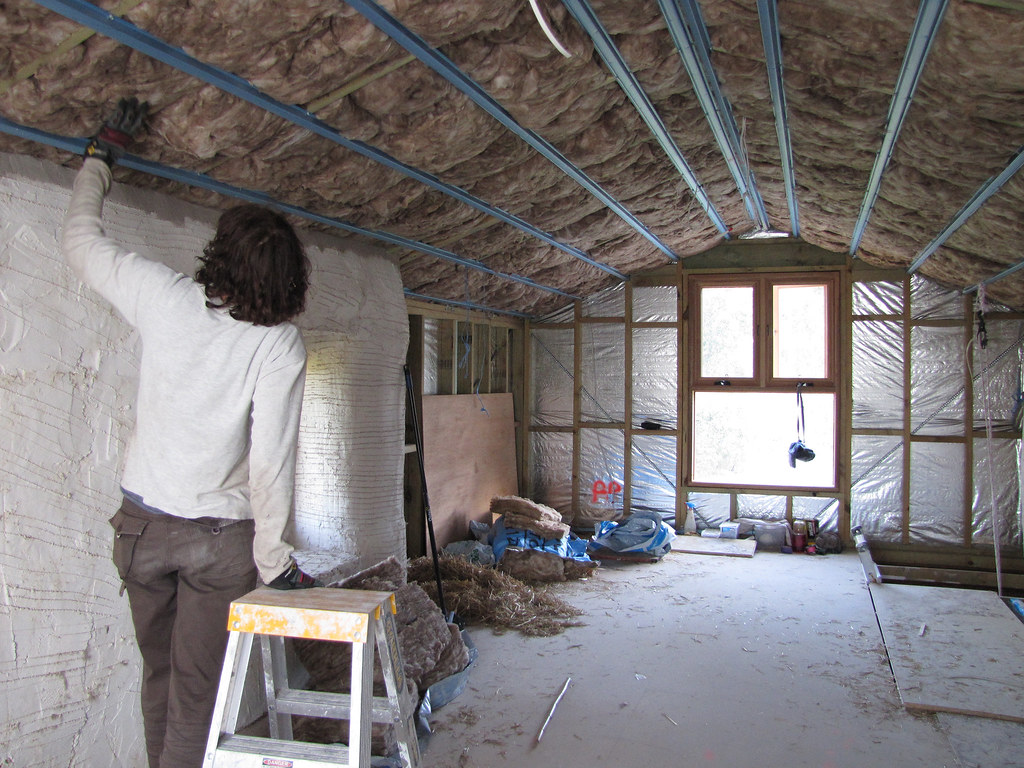
When attics are inhabited or intended for conversion, insulation is applied directly under the roof covering, between the rafters or along the sloped ceiling. The goal is to create a continuous thermal envelope without sacrificing headroom.
Two approaches are available:
- Sarking (from outside): rigid boards are placed above the rafters under the roofing. Very effective, this method is ideal during a full roof replacement.
- From inside: insulation is fitted between the rafters, topped with a vapour barrier, then covered with an interior lining. Less efficient than sarking but more accessible as a renovation option.
Comparison of Insulation Materials for Attics
The choice of insulation depends on the attic type, budget, performance targets and environmental considerations.
| Material | Lambda (W/m.K) | Average price (€/m²) | Attic type | Environmental impact |
|---|---|---|---|---|
| Glass wool | 0.030-0.040 | 5-15 | Cold loft, converted | Medium |
| Rock wool | 0.034-0.045 | 8-18 | Cold loft, converted | Medium |
| Cellulose wadding | 0.038-0.042 | 10-20 | Cold loft (blown-in) | Low |
| Hemp wool | 0.038-0.045 | 15-30 | Converted attic | Low |
| Wood wool | 0.038-0.050 | 15-35 | Converted attic | Low |
| Polyurethane (PUR) | 0.022-0.028 | 25-45 | Narrow rafter spaces | High |
Glass wool remains the most economical and widely used insulator. Cellulose wadding, made from recycled paper, is increasingly popular for its low carbon footprint and good acoustic performance. Polyurethane is reserved for spaces where available thickness is very limited (narrow rafters).
How Much Does Attic Insulation Cost in 2026
The final price depends on the surface area, chosen technique and geographical area. Here are the price ranges observed in 2026:
Cold loft by blown-in method:
- Average cost: 20 to 45 €/m² including labour
- For 50 m²: between 1,000 and 2,250 €
- For 100 m²: between 2,000 and 4,500 €
Converted attic (rafter insulation):
- Average cost: 40 to 80 €/m² including labour
- For 50 m²: between 2,000 and 4,000 €
- For 100 m²: between 4,000 and 8,000 €
These prices apply to certified RGE contractors. A 20 to 30% variation exists between regions. Obtaining at least three comparative quotes before committing is strongly recommended.
Once the attic is properly insulated, the efficiency of the heating system improves noticeably. For homes heated with wood, working with a reliable firewood supplier helps optimize consumption and extends the benefits of the insulation investment.
Financial Grants Available in 2026
Several cumulative schemes allow homeowners to significantly reduce out-of-pocket costs:
MaPrimeRenov’: France’s main state grant, calculated according to household income. Low-income households can receive up to 75% of the works cost. The application is submitted on france-renov.gouv.fr before the works begin.
Energy Savings Certificates (CEE): premiums paid by energy suppliers (EDF, Engie, TotalEnergies, etc.) to homeowners carrying out energy efficiency works. Cumulative with MaPrimeRenov’, they further reduce the final cost.
Reduced VAT at 5.5%: applicable to all thermal insulation works in homes completed more than 2 years ago.
Eco-PTZ: interest-free loan of up to 50,000 € to finance energy renovation works, with no income condition. Available through all approved banks.
France Rénov’: a free single-window service that supports homeowners from start to finish, from the energy audit to obtaining grants. A France Rénov’ advisor can also refer to local certified RGE contractors.
The requirement to use a certified RGE (Reconnu Garant de l’Environnement) contractor applies to receive MaPrimeRenov’ and CEE grants. Certifications can be checked on qualibat.com or faire-soi-meme.fr.
Common Mistakes to Avoid for Successful Insulation
Neglecting ventilation. High-performance insulation without adequate air renewal (single or double-flow VMC) leads to moisture and condensation problems. Both projects should be addressed together or in immediate sequence.
Forgetting the vapour barrier. For converted attics and rafter insulation, the vapour barrier protects the insulation from interior condensation. Its absence significantly shortens the insulation lifespan and encourages mould growth.
Underestimating the required thickness. The minimum recommended thermal resistance for attics is R = 7 m².K/W in new builds (RE2020) and at least R = 6 m².K/W in renovation. Insufficient thickness compromises the expected energy savings.
Leaving thermal bridges. Zones around roof timbers, walls and pipes are weak points. Careful treatment of these areas (expanding polyurethane foam, sealing strips) is essential to avoid cancelling out the insulation benefits.
Choosing a non-RGE certified contractor. Beyond losing financial grants, poorly executed work by an unqualified professional can cause pathologies (condensation, moisture, structural timber damage) that are difficult and costly to correct.
Any renovation project by trade - whether attic insulation, bathroom renovation or kitchen remodelling - benefits from being part of a planned global programme to optimize grants and sequencing of tradespeople.
Frequently Asked Questions
What is the best solution to insulate an attic?
For cold lofts, blown-in mineral wool or cellulose wadding offers the best value: quick to install, affordable and effective over large surfaces. For converted attics, between-rafter insulation with rock wool or wood wool is the most efficient technique. The choice depends primarily on the attic type, accessibility and available budget.
How much does it cost to insulate 100 m2 of cold loft?
For 100 m² of cold loft insulated by the blown-in method, the budget ranges from 2,000 to 4,500 euros including labour. This amount varies depending on the chosen material, attic accessibility and region. Available grants (MaPrimeRenov’, CEE, reduced VAT) can significantly reduce this cost, sometimes up to 75% for low-income households.
How to insulate your attic yourself?
Cold loft insulation using rolls is accessible to experienced DIYers. First check the condition of the roof structure, lay a vapour barrier if necessary, then unroll the insulation in crossed layers to avoid thermal bridges. Blown-in insulation, however, requires professional equipment and is not suited to DIY. For converted attics, using a certified RGE contractor is recommended to ensure quality and access available grants.
How to insulate an attic on a budget?
Glass wool and rock wool are the least expensive materials on the market. Combining MaPrimeRenov’ and CEE grants significantly reduces out-of-pocket costs. Under certain income conditions, CEE schemes can cover a large portion of the cost. Comparing quotes from several certified RGE contractors remains the best way to obtain the most competitive price.